6G-SMART Timeline
Scroll down to check out what we have been up to since the beginning of the project.
-
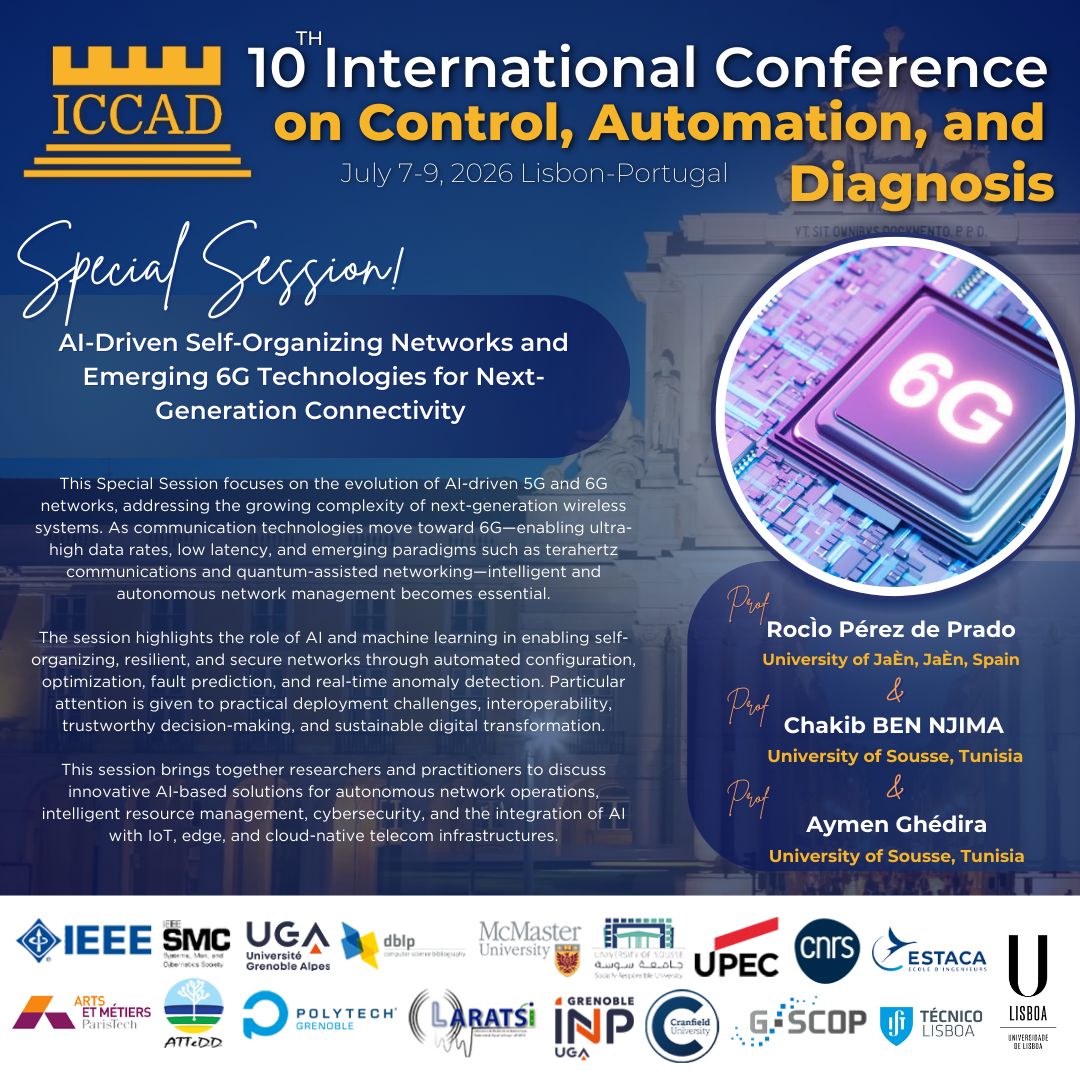
IEEE/IFAC ICCAD 2026
07 July – 09 July, 2026
Within the framework of the 6G-SMART European Project, the consortium is pleased to announce that the project partner University of Jaén is organizing the Special Session:
“AI-Driven Self-Organizing Networks and Emerging 6G Technologies for Next-Generation Connectivity” at the IEEE/IFAC 10th International Conference on Control, Automation and Diagnosis (ICCAD’26), taking place July 7–9, 2026, in Lisbon, Portugal.
ICCAD’26 is technically sponsored by The International Federation of Automatic Control (IFAC), IEEE Systems, Man and Cybernetics Society, Polytechnic University of Catalonia, University of Lisbon, Polytech Grenoble, DBLP, and the IEEE Society (#69956).
📃 The Conference details can be accessed: Here!
📃 The Call for Papers can be accessed: Here!
The Special Session will explore how Artificial Intelligence and Machine Learning are enabling autonomous, resilient, and secure 5G/6G networks. Topics include AI-driven self-organizing networks, spectrum optimization, terahertz and emerging 6G architectures, cybersecurity, intelligent orchestration, and sustainable network automation.
This session will also serve as a platform to disseminate some advances aligned with the 6G-SMART vision and to strengthen collaboration between academia and industry.
📆 Extended submission deadline: March 27, 2026
Researchers and industry professionals are warmly invited to attend and to submit their contributions and join us in shaping the future of AI-driven next-generation connectivity.
📆 Stay tuned for updates as we keep looking forward to future collaborations and continued innovation in wireless communications!
-
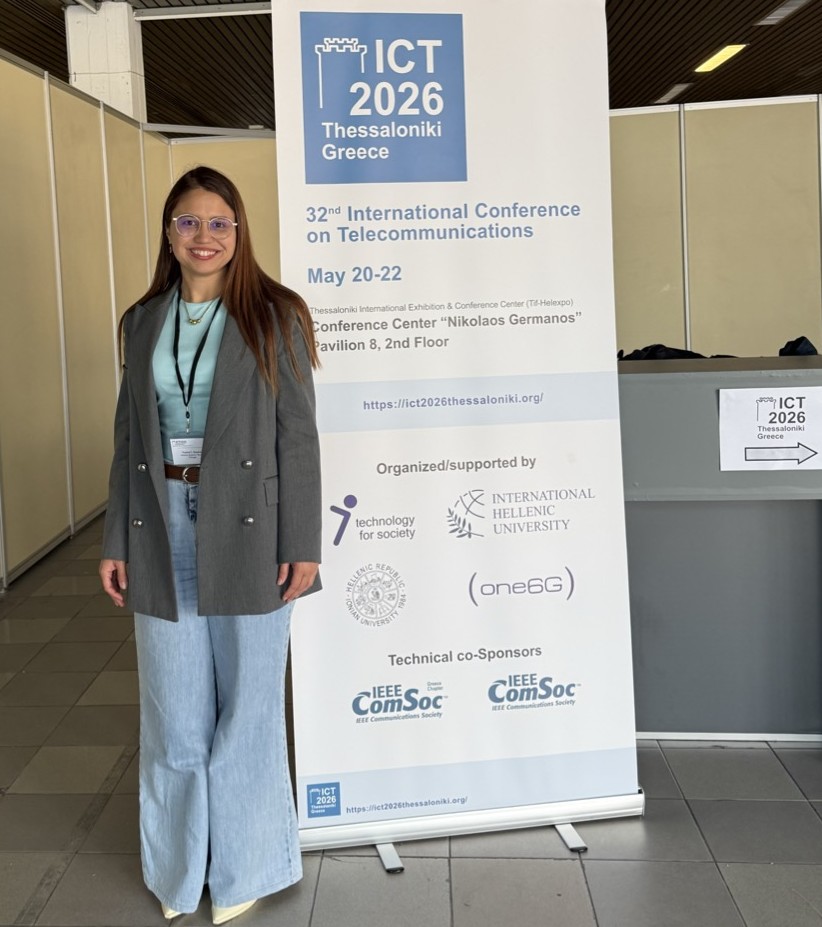
ICT 2026 - COOPER
20 May – 22 May, 2026
🚀 Recently, Cyient had the opportunity to present the latest research article at the International Conference on Telecommunications (ICT 2026), an excellent event that facilitates collaborations, discussions and knowledge exchange while revealing the latest trends and innovations in mobile networks.
The article “COOPER: An Open Dataset of Synthetic Mobile Network Performance Indicators for Reproducible Research” introduces Cellular Operational Observations for Performance and Evaluation Research (COOPER), in honour of Martin Cooper. COOPER is an open-source synthetic dataset of multi-cell 5G performance management time series comprising 45 indicators across multiple categories. This dataset is designed to reproduce the statistical, temporal, and inter-variable characteristics of an operational network. Three synthetic data generation paradigms, adversarial, probabilistic, and model-based, are evaluated using a unified framework assessing distributional similarity, temporal fidelity, dependency preservation, protocol consistency, and forecasting accuracy.
Special thanks to the authors Marco Sousa, Madalena Cilínio, Thaína Saraiva, Luís Mata, and Pedro Vieira, to the 6G-SMART project consortium, to Instituto de Telecomunicações, Instituto Superior Técnico de Lisboa and Instituto Superior De Engenharia De Lisboa for their valuable support.
🔎 The COOPER dataset was made publicly available on Hugging Face to encourage further research and development and can be accessed: Here!
📆 Stay tuned for updates as we keep looking forward to future collaborations and continued innovation in wireless communications!
-
ICT 2026
20 May – 22 May, 2026
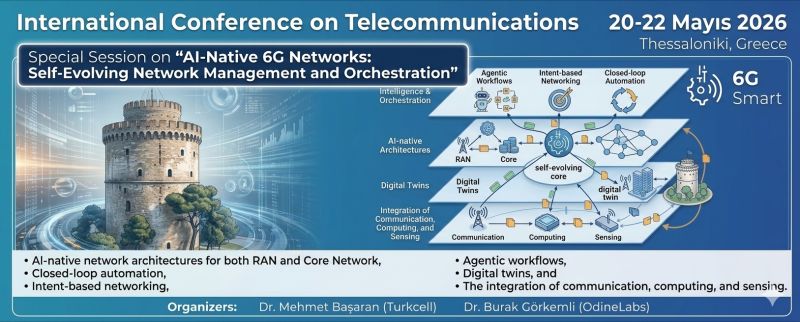
🚀 We are organizing a special session on “AI-Native 6G Networks: Self-Evolving Network Management and Orchestration” at the famous ★International Conference on Telecommunications (ICT 2026)★
🌐 Turkcell and Odine, Turkish consortium partners in the 6G-SMART project, are leading a prestigious Special Session at the International Conference on Telecommunications (ICT 2026), taking place May 20-22, 2026, in Thessaloniki, Greece.
The event is technically supported/endorsed by the IEEE Communications Society, one6G Association and Papers/Demos/Posters/PhD Symposium will be published at IEEEXplore!
📍 Special Session Title: "AI-Native 6G Networks: Self-Evolving Network Management and Orchestration"
🔜 Extended Submission Deadline: 05-April-2026 (firm).
This session will contribute to shaping the future of AI-native network management and orchestration. It will provide a platform to present novel theoretical advances, experimental results, and practical deployments, while also addressing open challenges such as data availability, model generalization, explainability, and standardization. Ultimately, the session seeks to accelerate thetransition toward intelligent, self-evolving 6G networks capable of delivering seamless, efficient, andresilient connectivity.
📡 As part of the 6G-SMART vision, this initiative highlights the importance of collaborative research and innovation in building scalable, efficient, and intelligent networks for the 6G era. This session will also serve as a platform to disseminate some advances aligned with the 6G-SMART vision and to strengthen collaboration between academia and industry.
We look forward to engaging with researchers, industry experts, and innovators to explore transformative ideas and solutions. Looking forward to welcome you in Thessaloniki this May for the ICT 2026 conference!
📆 Stay tuned for updates as we keep looking forward to future collaborations and continued innovation in wireless communications!
-
IEEE IJCNN 2025
30 June – 05 July, 2025
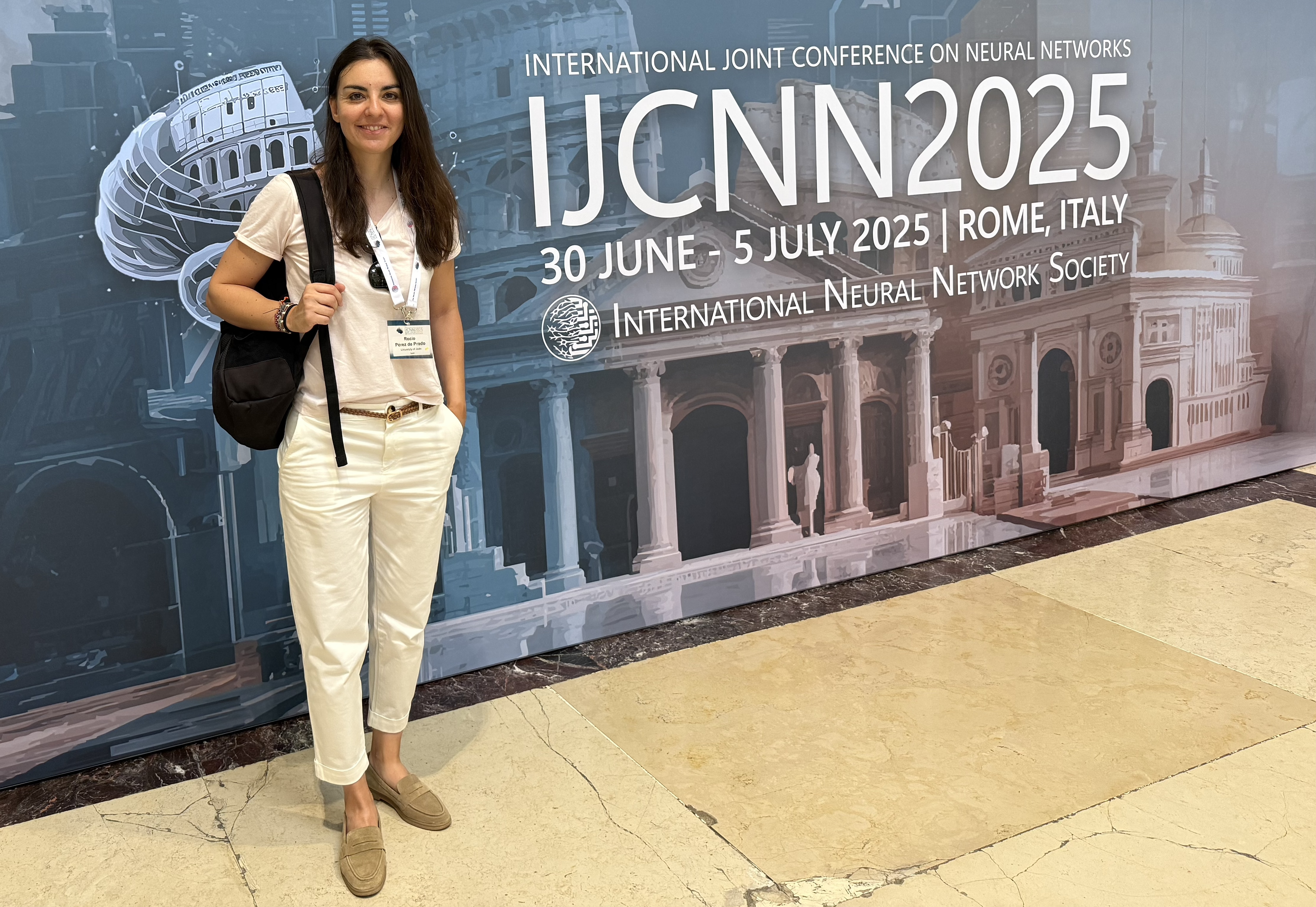
Recently, the University of Jaén had the opportunity to present a research article at the 2025 International Joint Conference on Neural Networks (IJCNN 2025), hosted at the Pontifical Gregorian University, in the city of Rome, Italy. This event brings together the brightest minds in neural networks and artificial intelligence, offering a platform for sharing ideas and fostering collaborations.
The paper “Digital Twin-Based Deep Q-Learning Strategy for Smart Handover Optimization in 5G/6G Networks”, presents a digital twin-based Deep Q-Learning (DQL) strategy to optimize handover processes and resource management in these networks. It is proposed to consider digital twins to support the implementation of real-time network conditions where DQL agents are trained to improve quality of service (QoS) parameters related to throughput. The suggested approach, deployed with the ns-3 mmWave module and ns3-ai framework, shows relevant benefits, including reduced handovers. Moreover, the consideration of digital twins allows adaptive learning and scalability, allowing networks to respond more effectively to dynamic user behavior and environmental modifications. These results underline the potential of combining DQL and digital twins as an efficient solution for smart handover management, and thus, for sustainable and efficient communication in 5G/6G networks.
📃 The full paper can be accessed: Here!
📆 Stay tuned for updates as we keep looking forward to future collaborations and continued innovation in wireless communications!
-
IEEE WCNC 2025
24 - 27 March, 2025
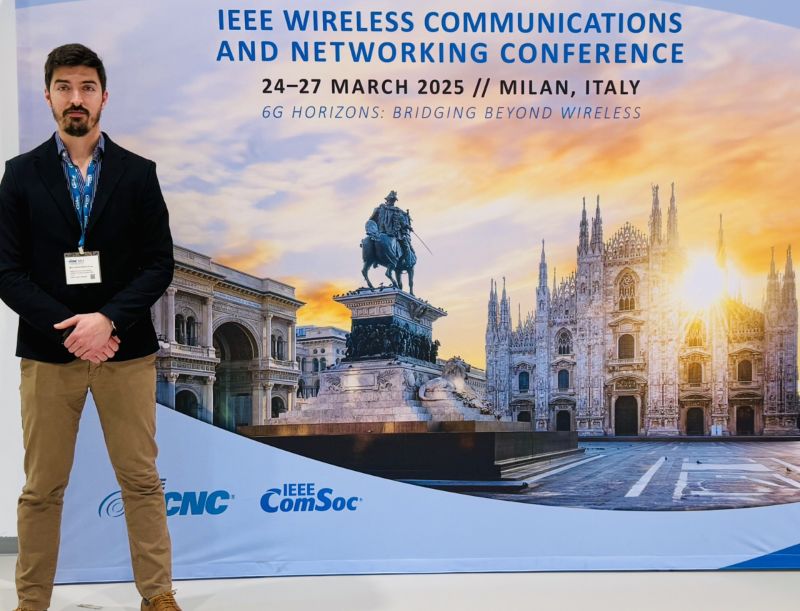
Recently, Celfinet a Cyient Company had the opportunity to present a research article at the IEEE Wireless Communications and Networking Conference (WCNC 2025), an excellent event where researchers and industry professionals discuss and explore advancements in wireless communication technologies.
The paper "Telco-DPR: A Hybrid Dataset for Evaluating Retrieval Models of 3GPP Technical Specifications," introduces Telco-DPR, an open-access dataset combining text and table formats from curated 3GPP documents. The dataset includes synthetic question-passage pairs designed to evaluate retrieval performance in telecom-focused question-answering systems. Our research showed significant improvements over traditional Retriever-Augmented Generation (RAG) methods. Specifically, our proposed system, integrating Dense Hierarchical Retrieval (DHR) with GPT-4, achieved a 14% improvement in answer accuracy compared to existing benchmarks.
📃 The full paper can be accessed: Here!
🔎 The Telco-DPR dataset was made openly available to encourage further research and development and can be accessed: Here!
Special thanks to the co-authors Pedro Vieira and António Rodrigues, and especially Thaína Saraiva as the first author, to the 6G-SMART project partners, Instituto de Telecomunicações, and ISEL - Instituto Superior De Engenharia De Lisboa for their valuable support.
📆 Stay tuned for updates as we keep looking forward to future collaborations and continued innovation in wireless communications!
-
6G-SMART Kick-off
01 November, 2024The 6G-SMART project has officially started.